Air and controls
HVAC and energy management
Commercial air conditioning and the energy management controls that run it, inspected, tested and repaired to cut consumption and extend equipment life.
Chapter 01
Where air conditioning loses capacity and money
Commercial air conditioning rarely fails all at once. It slides. Coils fouled by salt air and dust move less heat, clogged filters starve the fan, worn belts slip, and contactors pit until a compressor stops starting. Drain pans and condensate lines back up and wet the ceiling below. In Puerto Rico, where a rooftop unit works most of the year, that slow slide has plenty of time to run.
The energy management side drifts in its own way. Schedules and setpoints get overridden during a hot week and never put back, so units run all night in an empty building. A sensor reads wrong, a controller is left in manual, and nobody notices because the building still feels fine. The electric bill is the only symptom, and it arrives a month later.
Refrigerant issues sit in between. A low charge shows up as a unit that runs constantly and never quite catches up, which hurts comfort and the electric bill together. Across a building with many units, one weak unit often pushes its neighbours to work harder to hold the same temperature.
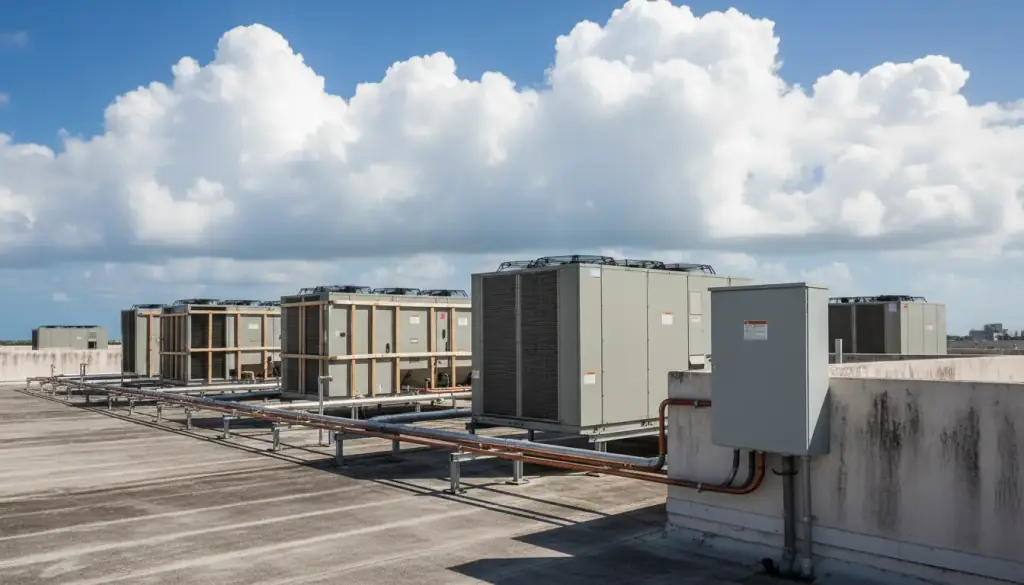
Packaged rooftop air conditioning units and refrigerant lines on a flat commercial roof under a tropical sky
What a visit to the roof and the controls looks like
A visit starts with the equipment itself. Our trained engineers and technicians go unit by unit across your HVAC air conditioning equipment, looking at coils, filters, belts, contactors, drain pans and condensate lines, then testing each unit with modern testing technology rather than judging by ear or touch. The same walk covers the energy management systems that schedule and control those units.
Testing is only half of it. The information collected is analysed, so a single reading is judged against the unit's own history and against its neighbours. Setpoints, schedules and sensor values on the energy management side are checked against how the building is actually used, which is where the quiet waste tends to turn up.
Then a complete, detailed report is issued. It sets out what the engineers found and what they recommend, in plain terms a facility manager can take to an owner or a board, with the items that need action called out so they are not buried among the ones that are only being watched. Maintenance, repairs and installation come from the same company.
Chapter 03
Lower consumption, longer equipment life
The reports exist to do three things: improve operations, reduce energy consumption and extend equipment life. For air conditioning that is practical. A clean coil and a correct schedule use less power for the same cooling, and a unit that is not forced to short-cycle or run through the night lasts longer before it has to be replaced.
ESS keeps electronic records of every service, so the condition of each unit can be tracked between inspections. Those records are always available to customers, which means a trend in a compressor or a controller can be seen before it becomes a breakdown. Preventive maintenance greatly reduces the risk of failures, and when a repair is needed it can be delivered on tight deadlines.
If a unit fails in the middle of a Puerto Rico summer, or after a storm, the line is open 24 hours a day, seven days a week at 787-944-3109. Installation is part of the work too, so replacing or adding equipment does not mean starting over with a new contractor who has never seen the building.
ESS has served commercial and industrial buildings across Puerto Rico and the Caribbean since 2009.