Generation on the roof
Solar and wind energy
Rooftop solar arrays, inverters and small wind turbines, inspected and tested so the generation you paid for keeps showing up.
Chapter 01
How solar and wind generation quietly slips
Solar output drops without an alarm. Dust, salt film and bird droppings soil the panels, a failing inverter throws a fault that nobody is watching for, and connectors loosen or corrode in the heat and humidity. One string underperforming does not trip anything. It just lowers the production number, month after month, and the loss goes unseen.
Racking and mounts take the next hit. Hurricane season in Puerto Rico puts wind load on every rooftop array, and a loosened clamp, a shifted rail or a cracked mount can be present long before the next storm tests it. Conduit, junction boxes and wiring on a roof also take sun and salt air for years.
Small wind turbines have their own wear: bearings that roughen, blades that chip or lose balance, and tower or yaw hardware that works loose under constant movement. A turbine that sounds slightly different, or produces less than it used to, is usually telling you something specific, if someone is there to listen.
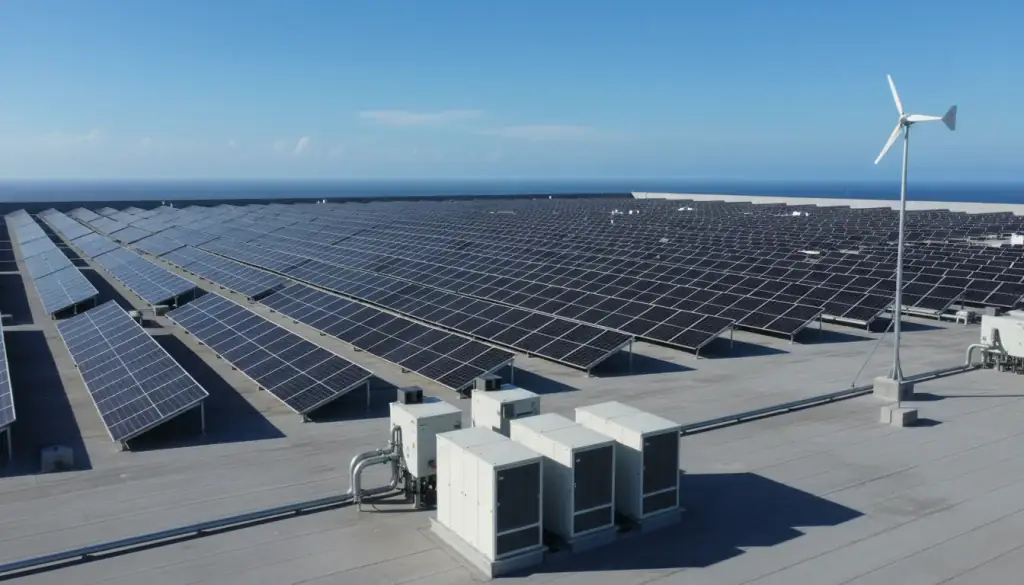
Rows of solar panels and a small wind turbine on the flat roof of a commercial warehouse by the sea
Inspecting, testing output and scanning for hot spots
ESS engineers and technicians inspect the array, the inverters, the disconnects, the wiring and the mounting, and the turbine hardware where a small wind turbine is part of the system. They then test the output, because a panel can look perfect and still be delivering less than it should.
Modern testing technology, including thermal scanning where it fits, shows hot spots in connections, combiner boxes and cells that the eye cannot see, and it can be done while the system keeps running. A warm connector today is a failed connector later, and a thermal image makes that visible before it costs anything.
The information collected is analysed, and a complete, detailed report follows with the findings and the recommendations. The report separates what needs repair now from what is simply worth watching, so the next visit has something concrete to compare against rather than starting from memory.
Chapter 03
Generation you paid for, checked after the storm
A solar or wind installation is an investment, and its value shows up as production. Keeping it maintained is how the generation you paid for keeps arriving. The aim of an ESS report is to improve operations and extend equipment life, and for generation equipment that means fewer silent losses and longer service from the inverters and turbines.
After a storm, check before relying on it. A system that came through a hurricane may look intact and still have damaged racking, a tripped inverter or water in a junction box. ESS works through natural disasters as well as ordinary weeks, and is on the job 24 hours a day, seven days a week.
Electronic service records are kept for every visit and stay available to customers, so production and condition can be compared between inspections. Repairs can be delivered on tight deadlines, and installation of solar and wind equipment is part of the same service. Call 787-944-3109 in Puerto Rico to arrange an inspection.
Whether it is an emergency, an equipment failure or a natural disaster, ESS is on the job 24 hours a day, seven days a week on 787-944-3109.