Water and air
Water pumps and ventilation fans
Booster pumps that keep water moving to every floor and the exhaust and ventilation fans that keep plant rooms, garages and kitchens breathing, maintained before they stop.
Chapter 01
Where pumps and fans quietly give out
Booster pumps fail in a familiar order. Mechanical seals weep, bearings grow noisy and hot, and a pressure tank that has lost its air charge makes the pump start and stop far more often than it should. Check valves chatter, pressure switches drift out of setting, and the tenants on the top floor are the first to notice weak water.
Exhaust and ventilation fans fail more quietly. Belts wear and slip, wheels pick up dirt and go out of balance, bearings and motors run until they seize, and dampers stick open or shut. Salt air in Puerto Rico speeds up corrosion on housings, fasteners and ductwork, so a fan that was fine two years ago may not be now.
Both kinds of equipment hide in rooms people rarely enter. A water pump can be running badly for months and the building will still have water, until the day it does not. A fan can turn without moving enough air, and the first sign is a garage that smells of exhaust or a kitchen that will not clear.
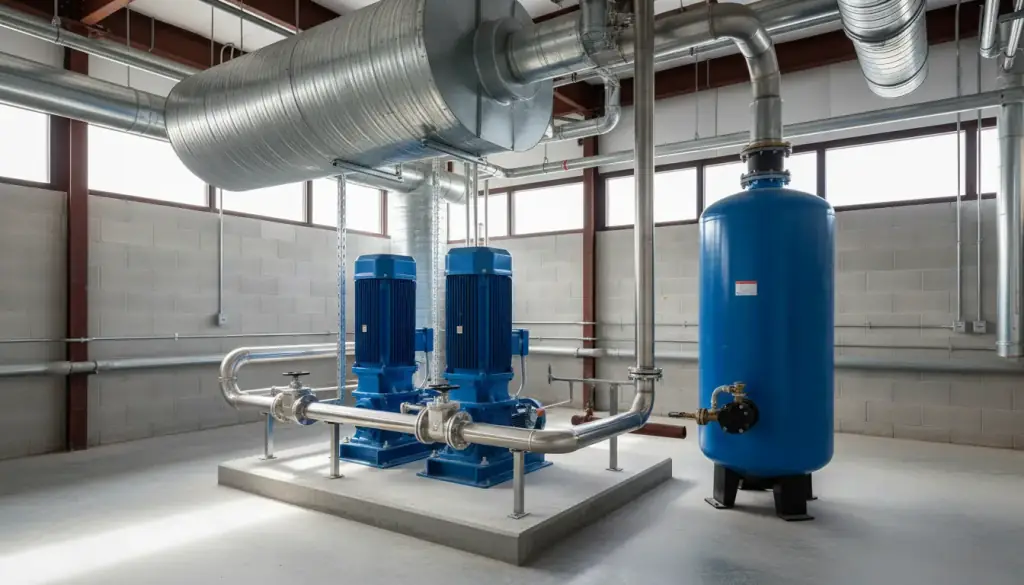
A pair of blue vertical booster pumps, a pressure tank and galvanized exhaust ductwork in a plant room
How we inspect, run and measure
Our trained engineers and technicians start by looking at each pump and fan where it sits: seals, bearings, couplings, belts, mounts, the pressure tank and the controls that start and stop them. Then they run the equipment and measure it with modern testing technology, so condition is judged on readings and not on guesswork.
The information collected is analysed, and the condition of each machine is recorded. That record matters because wear shows up as a change over time, a bearing a little warmer or a pump cycling a little more often than it did last visit, and a single visit cannot see a trend by itself.
Afterward a complete, detailed report is issued with findings and recommendations, written to help improve operations, reduce energy consumption and extend equipment life. A worn belt on an exhaust fan and a failing seal on a booster pump get listed plainly, in the order they should be dealt with.
Chapter 03
Water to every floor, air in every plant room
When a booster pump stops, a building loses water on its upper floors and tenants notice within the hour. When an exhaust fan stops, garages, kitchens and plant rooms stop clearing air. These are not showpiece systems, but a building cannot operate without them, and failures can lead to costly breakdowns, personal injury or property damage.
Preventive maintenance greatly reduces that risk. The electronic records ESS keeps of every service are always available to customers, so the condition of each pump and fan can be tracked between inspections. When repairs are needed they can be delivered on tight deadlines, and installation of new pumps or fans is part of the same service.
Across Puerto Rico and the Caribbean, ESS has looked after commercial and industrial buildings since 2009. If a pump or fan fails outside office hours, call 787-944-3109 at any time of day or night, because ESS is on the job 24 hours a day, seven days a week, through equipment failure and natural disaster alike.
Every ESS evaluation ends in a complete, detailed report of findings and recommendations, and the electronic service records behind it are always available to customers.