How rooftop air conditioning and energy controls waste money in salt air and heat
Most of the waste isn't a breakdown. It's a coil that can't shed heat and a schedule that no longer matches the building.
October 26, 2026 · 3 min read
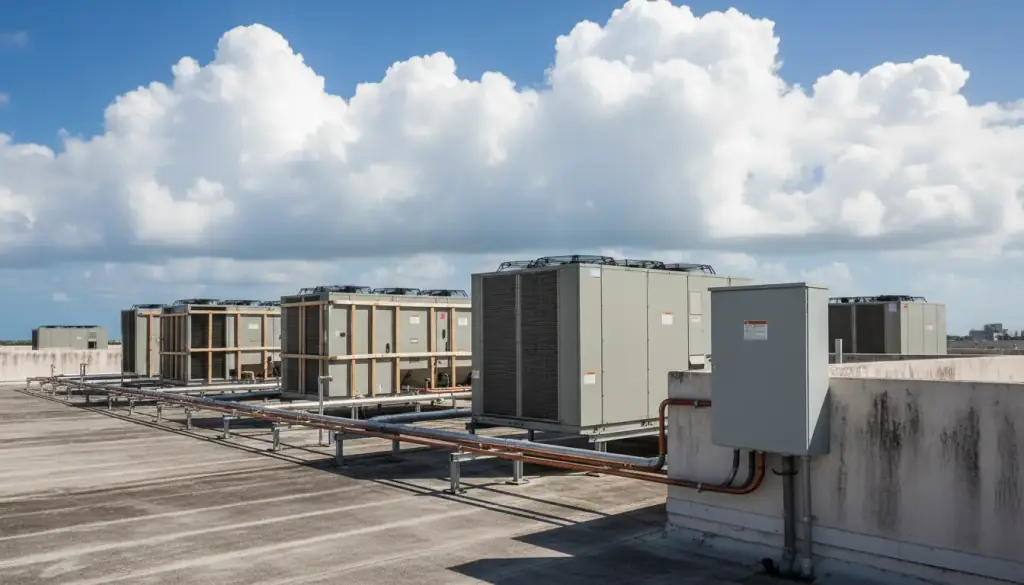
A cooling system rarely announces that it is wasting energy. The building stays comfortable, the units keep running, and the electric bill is simply higher than it should be. In coastal heat the usual cause isn't a failed part. It is slow decline: equipment working harder than it needs to, and controls that no longer match how the building is used.
Coils: where salt and dust do their damage
An air conditioner moves heat by passing air across coils. The condenser coil on the roof rejects heat to the outdoor air, and it only works when air can move freely through the fins. Salt-laden air, airborne dust, pollen, leaves and the grime that rooftops collect all build up on those fins. A fouled coil can't reject heat well, so the compressor runs longer and hotter to do the same job.
Near the coast there's a second problem, because salt corrodes, and a rooftop gets the full dose of it with no shelter from sun, wind or rain. Fins thin out and crumble, tubes pit, fasteners and panels rust. A coil that is only dirty can be cleaned. A coil that has corroded through has to be replaced. The difference between the two is usually how long it was ignored.
The rest of the unit
- Filters: clogged filters starve the coil of airflow and make the fan work harder.
- Belts and bearings: worn belts slip and cut airflow without any alarm.
- Contactors: pitted contacts cause hard starts and failures that look random.
- Drain pans and condensate lines: blocked drains lead to overflow, water damage and mold.
- Refrigerant: a low charge shows up as long run times and weak cooling, not always as an obvious leak.
Each item on that list costs a little. Together, in a building with dozens of units, they cost a lot, and none of them shows on a thermostat. The room can read the right temperature while a unit works twice as hard as it should to get there, and the only evidence is a meter nobody compares month to month.
Controls: schedules and setpoints drift
An energy management system can save real money, and it can also quietly do the opposite. A schedule is set when the building opens. Then a tenant asks for an early start, someone overrides a zone for an event, a holiday schedule is switched on and never switched off, and a setpoint gets nudged to stop a complaint. A year later nobody can say what the schedule is supposed to be.
The classic symptom is units running all night in an empty building. Another is occupied space held far colder than anyone asked for. Sensors drift too. A temperature sensor reading two degrees off tells the controls to keep cooling a space that is already comfortable.
What to look at
You don't need special tools to start. Pull up the schedule for each zone and compare it with when people are actually in the building. Look for overrides that have no end date. Compare the temperature the control system reports with a handheld reading in the same space. Check runtime hours on units that should be off at night.
Then go up on the roof. Shine a flashlight through the coil from the side: can you see light through the fins? Look for corrosion on panels and frames, standing water in pans, belts that look glazed or frayed. Listen for noises that weren't there last month.
Write down what you find, with the date. Next month you will know whether a unit is the same, better or worse, and that comparison is worth more than any single visit.
Inspection and testing, then a report
Walking the roof tells you what a unit looks like. Testing tells you how it performs. Specialized Maintenance Services (ESS) inspects and tests the equipment and its controls, analyzes the information collected, and issues a report with findings and recommendations to help reduce energy consumption and extend equipment life. Electronic records of each service stay available to the customer, so a unit's condition can be compared across visits. That fits this problem well, because the waste lives in small details that only a comparison reveals.
For the roof and the controls together, see the HVAC Air Conditioning and Energy Management Systems service pages. For a unit that has quit in the heat, the 24/7 line is 787-944-3109.
Specialized Maintenance Services, 787-944-3109
Call 787-944-3109More articles
What a standby generator needs before hurricane season
Most storm-night generator failures are small, boring faults that a load test and a look at the transfer switch would have caught.
Fire pump and fire alarm faults that go unnoticed between inspections
Fire systems sit idle for months, so the faults that matter are the ones nobody sees until the day the system is called on.