What a standby generator needs before hurricane season
Most storm-night generator failures are small, boring faults that a load test and a look at the transfer switch would have caught.
October 26, 2026 · 4 min read
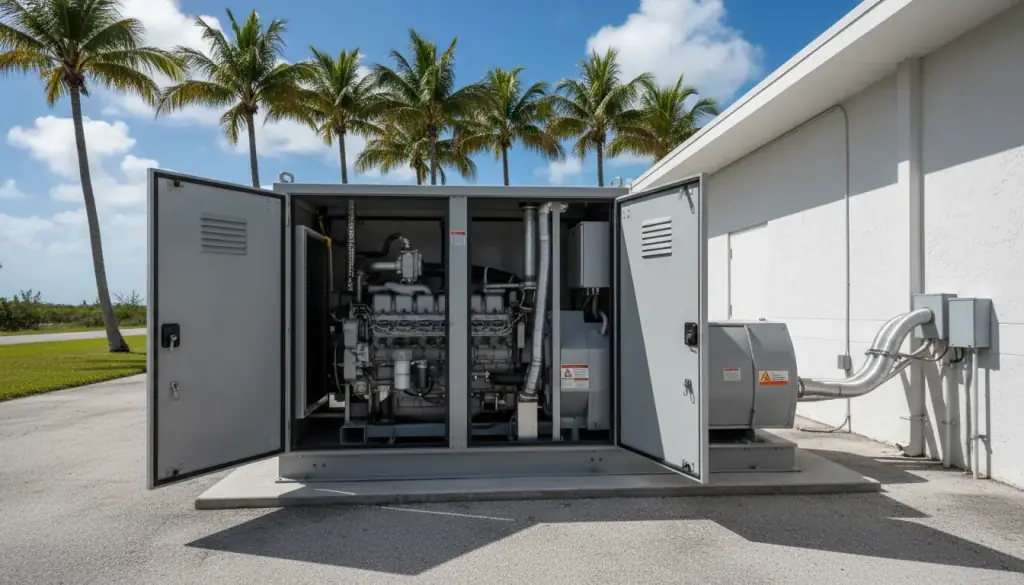
Most generator failures in a storm aren't dramatic. The engine doesn't blow up. It just doesn't start, or it starts and the building never moves onto it. Someone walks into the plant room with a flashlight, finds a dead battery or a switch that won't throw, and the outage the generator was supposed to cover becomes a long night of phone calls.
The frustrating part is how ordinary the causes are. A standby generator spends nearly its whole life idle, and idle machines pick up problems that machines in daily use never see. If you manage a building in Puerto Rico, the weeks before the season starts are the time to look for them.
Start with what actually fails
The usual suspects are short and unglamorous. None of them shows up when you glance at the unit, and a control panel can only report what its sensors are able to see.
- Starting batteries that have lost capacity or grown corrosion on the terminals, so the engine cranks slowly or not at all.
- A battery charger that quietly died, which means the batteries were fine three months ago and are flat now.
- Diesel that has aged in the tank, picked up water, or dropped sludge on the bottom that clogs filters the first time the engine pulls hard.
- Coolant that is low or tired, and block heaters that stopped working, so the engine is cold and slow to take load.
- Louvers and exhaust paths blocked by stored boxes, debris or vegetation.
Why load testing is not the same as running it
Starting the generator and letting it idle for ten minutes proves the engine starts. It proves very little else. An engine that runs with no load tends to run cool, burn fuel incompletely and leave deposits behind. An idle run also never tells you whether the alternator can hold voltage and frequency when the building asks for real current.
Putting the unit under load, in steps and long enough to reach normal operating temperature, is what exposes weak fuel delivery, overheating, a governor that hunts up and down, or a breaker that trips. It is also the only way to watch the whole chain work together: engine, alternator, controls, switch and the loads on the far side of it. Where a full building transfer isn't practical, a load bank can supply the demand instead. The goal is the same either way. Find the weakness while the grid is still up and a technician can fix it in daylight.
The transfer switch is half the system
Owners talk about the generator and forget the transfer switch, but the switch is what actually moves the building from utility power to generator power and back. It is a mechanical device that may go a year without moving. Contacts get dirty, mechanisms stiffen, control relays drift, and the timers that decide how long it waits before starting the engine or switching back may not be what anyone intended.
Exercise it. Operate it under supervision, watch it transfer, and confirm that the loads that should be on generator power really are. Make sure it returns cleanly to the utility when power comes back. Inspect the contacts and lugs for heat damage, which leaves discoloration and a smell you learn to recognize.
Thermal scanning helps here. A scan of the switch and the distribution it feeds, done while it carries load, shows a loose or failing connection as a hot spot before it becomes an outage, and it can be done without shutting the building down.
Walk the fuel and the room
Fuel is the part people trust most and check least. Know how much is in the tank, when it was last tested or cleaned, and whether the day tank, the transfer pump and the float controls actually work. A tank that reads half full of old fuel isn't half the runtime you think it is.
Then look at the room itself. Is there clear air coming in and going out? Is the exhaust intact? Are there oil, coolant or fuel drips on the floor or around the hoses? Are the belts and hoses cracked? A wet spot under the engine tells you more than any display on the panel.
Write everything down. Next to the date of each test, record battery condition, fuel level, run hours, oil and coolant state, and what happened at transfer. Two years of those pages show you which parts are aging long before one of them fails.
What a pre-season service should hand you
A useful service before storm season isn't an oil change and a sticker. It is an inspection, a run, a load test where appropriate, a transfer switch check, and a written list of what was found and what to do about it. That is how Specialized Maintenance Services (ESS) works on generators. The company has maintained electrical and mechanical equipment in commercial and industrial buildings in Puerto Rico and the Caribbean since 2009, and each job ends in a complete, detailed report with findings and recommendations. The electronic service records stay available to the customer, so the condition of the unit between visits isn't a guess.
Then act on the list early. Getting a part and a technician for a repair in a quiet week is far easier than getting them when every building on the island is calling at once.
If you can't say when your generator last carried a real load, that is the answer you need before the season, not during it. The Electrical Generators service page describes what ESS covers, and the 24/7 emergency line is 787-944-3109.
Specialized Maintenance Services, 787-944-3109
Call 787-944-3109More articles
Fire pump and fire alarm faults that go unnoticed between inspections
Fire systems sit idle for months, so the faults that matter are the ones nobody sees until the day the system is called on.
Predictive and preventive maintenance in plain terms, and what thermal scanning finds
One works from the calendar and the other from the equipment's actual condition, and the best programs use both.